

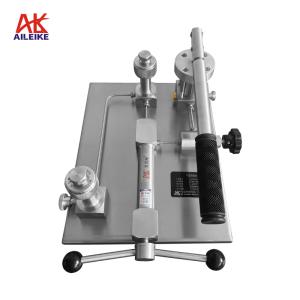
A Comprehensive Guide to the Full Process of Calibration, Testing and Measurement of Aileko ALKT511 and ALKC400A Pressure Switches
A Comprehensive Guide to the Full Process of Calibration, Testing and Measurement of Aileko ALKT511 and ALKC400A Pressure Switches
Pressure switches are the core components responsible for pressure monitoring in industrial pressure measurement and control systems; the accuracy of their set-point and reset values affects system operation, and carrying out calibration, testing and measurement is a crucial step in ensuring equipment performance. This procedure utilises the ALKT511 low-pressure calibration bench and the ALKC400A digital pressure calibrator as its core tools. It strictly adheres to standard operating procedures, including compliance with environmental specifications for temperature and humidity, equipment connection and wiring verification, as well as the item-by-item determination of make and break contact set points and reset points. Through standardised pressure application and calibration, pressure reduction and re-testing, and data recording, the operational performance of the pressure switch can be accurately verified, ensuring that set points are both accurate and reliable.
I. Tools for Calibrating Pressure Switches
|
Name |
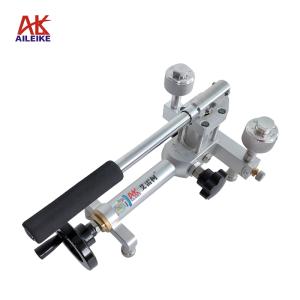
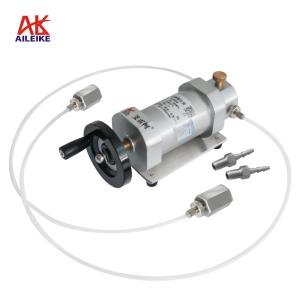
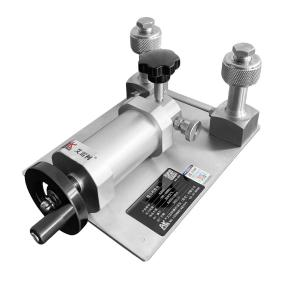
Low-pressure calibration bench |
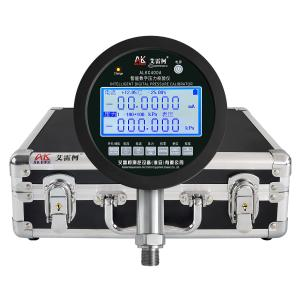
Digital Pressure Calibrator |
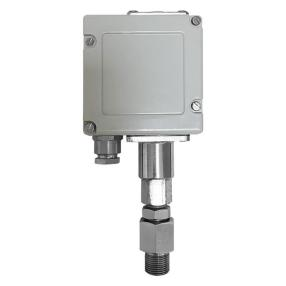
Pressure switches |
|
Model |
ALKT511 |
ALKC400A |
Various models |
|
Technical Specifications |
Pressurisation method: Manual Pressure: 0–600 kPa Medium: Clean air Outlets: 2 Connection: M20×1.5 (F) Net weight: 4.6 kg Product dimensions: 320×190×140 mm |
Pressure: 0–600 kPa Accuracy: 0.02% FS Temperature compensation: With temperature compensation Current measurement: ±25.0000 mA Voltage measurement: ±50.0000 V DC output: 24 V DC Communication interface: RS-232/RS-485 Power supply: Built-in rechargeable battery Connection: M20×1.5(M) Net weight: 1 kg Dimensions: 156 × 47 × 239 mm |
Pressure switch: 0–600 kPa Set point: 250 kPa Contact type: Normally open/normally closed switch Wetted parts material: Stainless steel Mounting thread: M20×1.5
|
|
Product Dimensions |
|
|
|
The entire verification process must be carried out in strict accordance with current metrological technical specifications. The main references include:JJG 544-2011 ‘Pressure Controllers’, which applies to the initial verification, subsequent verification and in-service inspection of pressure, vacuum and pressure-vacuum controllers (including mechanical and electronic types); these are pressure control devices that operate without an external power supply and rely on pressure changes to directly drive mechanical components to close or open contacts.
II. Detailed Explanation of the Operational Process
(1) Preliminary Preparations
1. Environmental Requirements
The temperature must be maintained at (20±2) °C, with relative humidity ≤85% RH and no condensation. Ensure that the site is free from vibration, dust and corrosive gases.
2. Connection of Equipment
• Connect the pressure switch and the ALKC400A digital pressure calibrator to the outlet of the ALKT511 low-pressure calibration bench using a sealed connection. Press the Switch/Peak button on the ALKC400A to switch to pressure switch measurement mode.
• Pressure switch pre-adjustment: Open the protective cover of the adjustment knob on top of the pressure switch, have the adjustment tool ready, and allow sufficient travel for clockwise (increase) and anti-clockwise (decrease) rotation to set the pressure switch setpoint.
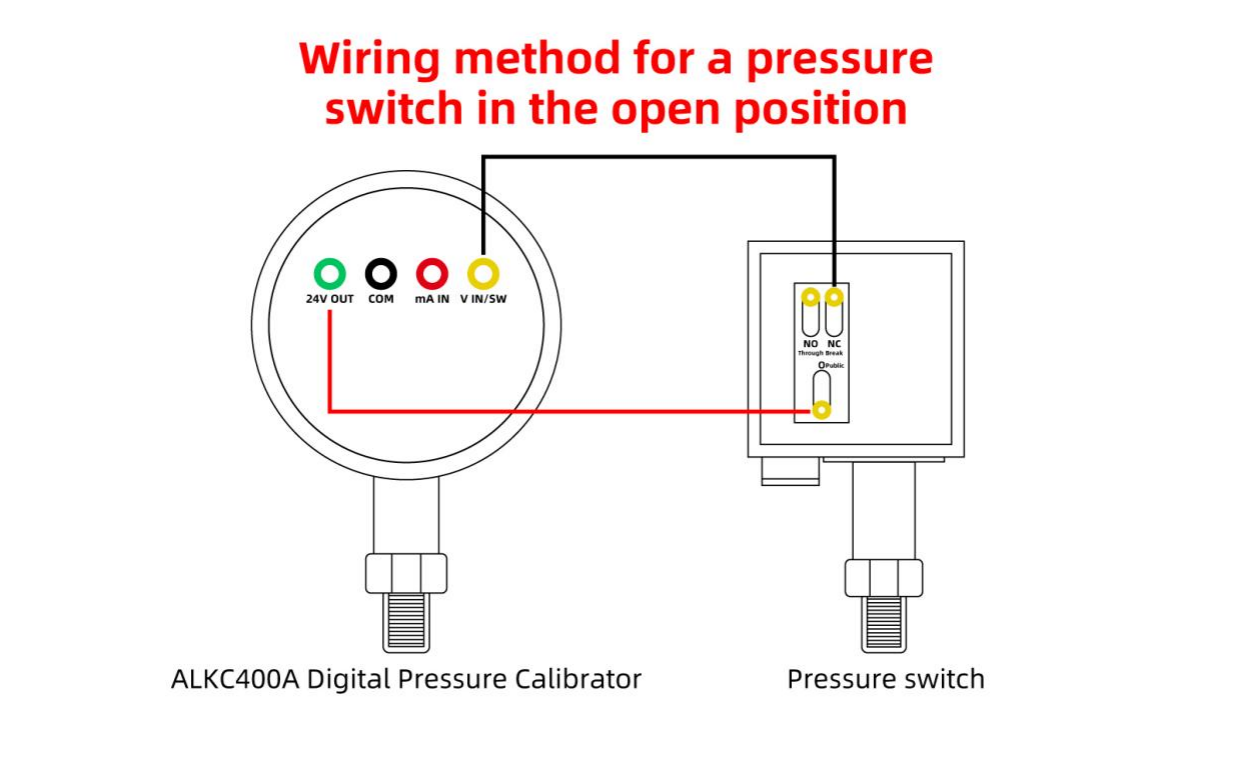
• Wiring instructions:
(1) Connect the red test lead of the ALKC400A to the 24V output terminal of the standard gauge, and the black test lead to the pressure switch measurement terminal.
(2) Clip the other end of the red alligator clip to the common terminal (COM) of the pressure switch, and the black alligator clip to the normally open (NC) or normally closed (NO) terminal.
(3) Now, first clip the black crocodile clip to the normally open (NC) terminal. At this point, the ALKC400A pressure switch display will show the word ‘Open’, confirming that the normally open (open circuit) state of the pressure switch is functioning correctly and that the wiring is correct.
(2) Procedure
Key calibration steps: Set the target pressure to 250 kPa. Rotate the pressure switch adjustment knob slightly (clockwise to increase pressure, anti-clockwise to decrease pressure), and, whilst applying pressure using the calibration bench, precisely calibrate the pressure switch’s actuation point to the target pressure of 250 kPa. Once calibration is complete, lock the knob in position.
1. Testing the closing and opening of the pressure switch in the normally open state
• First, open the ALKT511 pressure-regulating valve, turn the fine-adjustment knob anti-clockwise until it stops, and close the relief valve.
• Use the fine-adjustment knob to increase the pressure clockwise to the upper threshold (actuation pressure) of 250 kPa. You will hear a ‘beep’ from the instrument, the contact status will change, and the switch test on the standard gauge interface will change from ‘open’ to ‘closed’. The pressure switch will switch from the open state to the closed state; record the actuation pressure value.
• Continue to reduce the pressure by turning the fine-adjustment knob anti-clockwise until the lower cut-off value (reset value) of 240 kPa is reached. You will again hear a ‘beep’ from the instrument, the contact status will change, the test indicator on the standard gauge will change from ‘closed’ to ‘open’, and the pressure switch will switch from the closed state to the open state. Record the reset pressure value.
• Once the test is complete, open the pressure relief valve to gradually release the pressure in the pipeline. When the pressure has been fully relieved to 0, the measurement is complete.
2. Testing the closing and opening of a pressure switch in the normally closed state
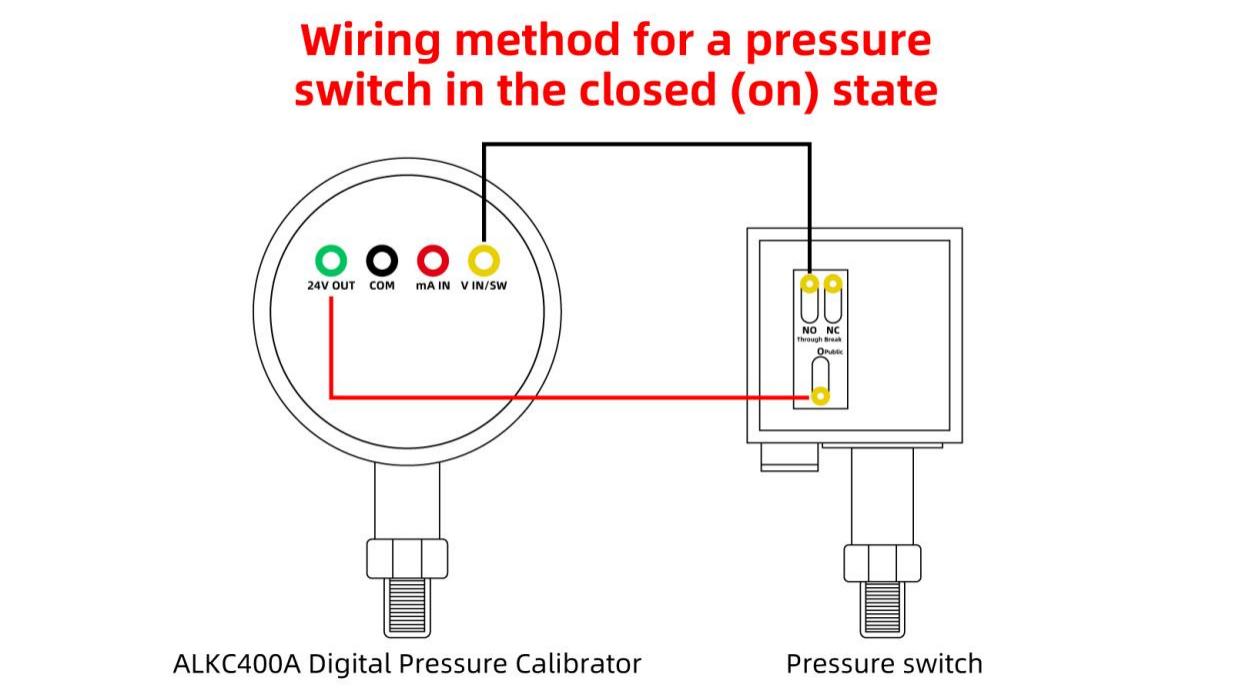
• First, clip the black alligator clip onto the normally closed (NO) terminal; you will then see that the pressure switch is in the normally closed state, and the ALKC400A standard pressure switch test display will show the word ‘Open’.
• Turn the fine-adjustment knob anti-clockwise until it stops, then close the pressure relief valve.
• Use the fine-adjustment knob to increase the pressure clockwise to the upper trip point (actuation point) of 250 kPa. You will hear a ‘beep’ from the instrument, the contact status will change, and the switch test on the standard gauge interface will change from ‘Open’ to ‘Closed’. The pressure switch will switch from the closed state to the open state; record the actuation pressure value.
• Continue to reduce the pressure by turning the fine-adjustment knob anti-clockwise until the lower cut-off value (reset value) of 240 kPa is reached. You will again hear a ‘beep’ from the instrument, the contact status will change, and the ‘Open’/‘Closed’ indicator on the standard gauge will change from ‘Open’ to ‘Closed’. The pressure switch will switch from the open state to the closed state; record the reset pressure value.
• Once the test is complete, open the pressure relief valve to gradually release the pressure within the pipeline. When the pressure has been fully relieved to 0, the measurement is complete.
III. Precautions
Proper Use
• Operations must follow standard procedures; pressurisation and depressurisation of the ALKT511 micro-pressure calibration bench must be carried out slowly to avoid pressure surges.
• Ensure correct wiring of the ALKC400A digital pressure calibrator; take great care to prevent reverse connection.
• Readings at the calibration point must be taken only after the standard gauge reading has stabilised, ensuring real-time accuracy.
• Upon completion of the test, first slowly depressurise to zero; the instrument under test may only be removed once all residual pressure has been fully released.
Maintenance and Calibration Schedule
• The ALKC400A digital pressure calibrator should undergo periodic metrological verification (recommended once a year) to ensure that measurement accuracy meets the required standards.
• Switch off the power supply when the pressure gauge is not in use; if it is not used for an extended period, it should be recharged once every three months.
• If the micro-pressure stand is not to be used for an extended period, it should be depressurised before storage and covered with a cloth cover to prevent dust from entering the instrument.
IV. Conclusion
By carrying out this calibration, testing and measurement of pressure switches, it is possible to accurately determine the actual deviation between the equipment’s actuation and reset values, and to verify the reliability of the switching of normally open and normally closed contacts. Operational requirements—such as strict environmental control, steady pressurisation and standardised readings—were rigorously adhered to throughout the process to ensure that the measurement results are accurate and reliable. By consistently carrying out periodic calibration and testing, and implementing equipment maintenance and servicing as part of routine operations and maintenance, the stable metrological performance of pressure switches can be sustained. This enables them to reliably perform their functions of pressure monitoring and interlock protection, thereby establishing a robust metrological defence for the long-term, stable operation of industrial pressure measurement and control systems.
Related News