English
 Portuguese
  Indonesian
  Russian
  Arabic
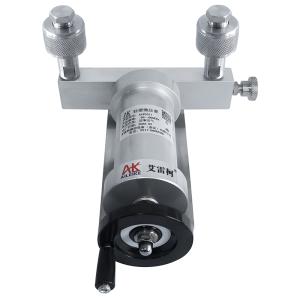
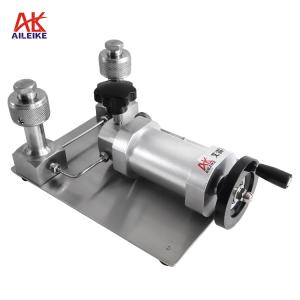
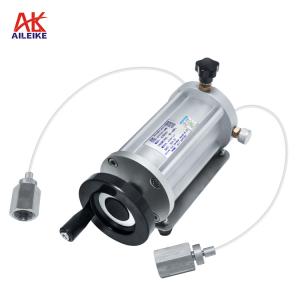
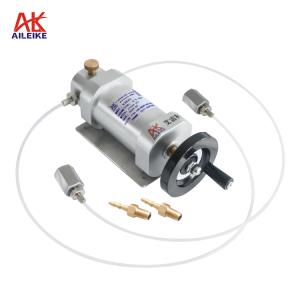
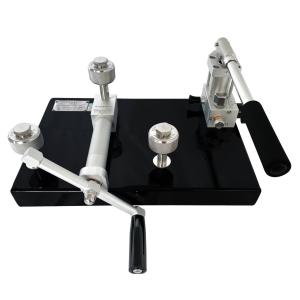
AILEIKE Portable Air Pressure Pump ALKB601 Technical White Paper
AILEIKE Portable Air Pressure Pump ALKB601
Technical White Paper
Product Overview and Technical Background
The AILEIKE Portable Air Pressure Pump ALKB601 is a manual pressure source designed for the precision calibration of medium- and low-pressure instruments. Featuring an open-frame design, it offers easy operation, smooth pressure ramping, reliable sealing, and simple maintenance. Suitable for both laboratory and field calibration scenarios, it is used for the calibration and verification of pressure gauges, pressure transmitters, pressure sensors, pressure switches, and other medium- and low-pressure instruments. It is widely used in metrology, scientific research, industrial and mining enterprises, and instrument manufacturing.
Technical Parameters and Performance Specifications
2.1 Basic Technical Parameters
|
Parameter Category |
Technical Specifications |
Notes |
|
Operating Environment |
Laboratory or Field Use |
Suitable for various working environments |
|
Ambient Temperature |
-10 to 60°C |
Wide operating temperature range |
|
Relative Humidity |
<80% |
Moisture-resistant design |
|
Pressure Range |
-0.095 to 1.6 MPa |
Supports both positive and negative pressure requirements |
|
Measured Medium |
Clean Air |
Excellent compatibility with various media |
|
Pressure Output |
2 |
Can connect both standard meters and test meters simultaneously |
|
Threaded Connection |
M20×1.5 or as specified by the user |
Flexible interface configuration |
|
Adjustment Precision |
min 10 Pa |
High-precision pressure regulation |
|
Dimensions |
280×200×180 mm |
Compact design |
|
Weight |
3.7 kg |
Easy to carry |
2.2 Key Performance Features
Positive/Negative Pressure Switching Technology: A unique positive/negative pressure switching valve design allows for easy switching between positive and negative pressure modes, expanding the device’s range of applications.
Quick-Connect Design: Equipped with two standard M20×1.5 pressure quick-connect ports, facilitating rapid connection to standard meters and test meters, thereby improving work efficiency.
High-Precision Pressure Control: Capable of pressure regulation with a minimum resolution of 10 Pa, ensuring precise pressure control.
Simple and Effortless Operation: The product features a rational structural design and intuitive operating procedures, significantly reducing operator workload and improving work efficiency.
High Portability: Weighing approximately 3.7 kg with moderate overall dimensions, the device is easy to carry and operate on-site, greatly enhancing work efficiency.
Main Application Areas
The lightweight air pressure pump ALKB601 has a wide range of applications across multiple sectors:
Industrial Sites: Daily calibration of pressure instruments in industries such as chemicals, power generation, and pharmaceuticals, adapted to specific operating conditions.
Metrology and Testing Institutions: Serves as a standard pressure source for the calibration and verification of pressure measuring instruments, ensuring the accuracy and consistency of measurement traceability.
Petrochemical Industry: Used for the calibration and testing of pressure instruments in the petrochemical sector to ensure the safety and efficiency of production processes.
Instrument Manufacturing: Used for quality inspection and calibration of products during the manufacturing of pressure instruments to ensure product quality meets standard requirements.
Research Institutes: Provides a precise and controllable pressure environment for scientific research experiments, supporting various pressure-related scientific studies and experimental work.
Operation and Maintenance Guide
Operating Procedure
Positive Pressure Testing
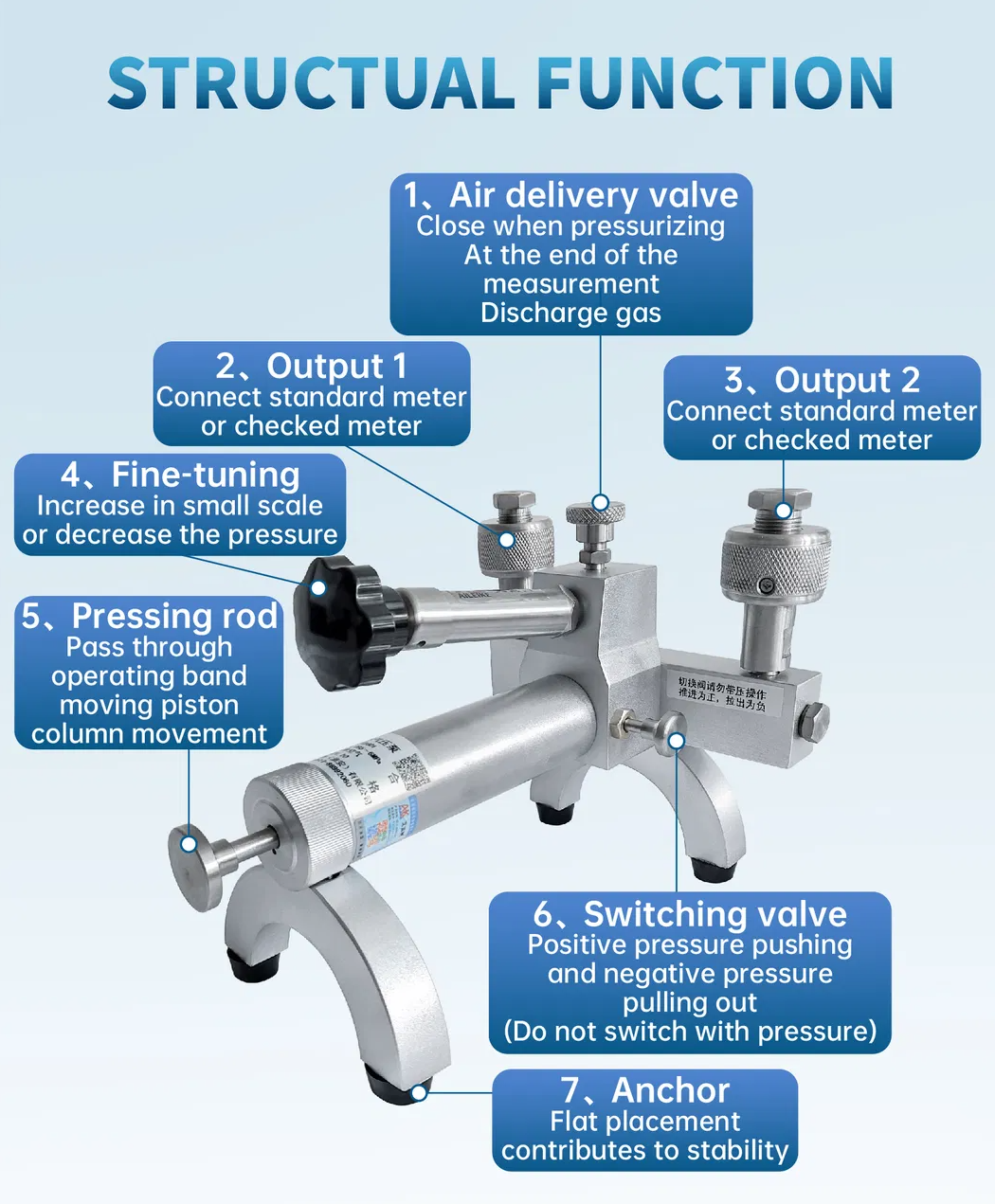
Unscrew the plug from the output port, turn the fine-tuning knob counterclockwise to its outermost position, push the switch valve to the positive pressure position (push inward), install the standard gauge and the gauge under test, close the air supply valve, and use the pressure-applying rod to repeatedly apply pressure until the desired pressure is reached. If the pressure-applying rod becomes difficult to operate, use the fine-tuning knob to adjust to the desired pressure. After calibration, relieve the pressure using the air supply valve. Only after depressurization may the meter under test and the standard meter be removed.
Negative Pressure Testing
Install the negative pressure standard meter and the meter under test on the two pressure output ports, respectively. Pull the selector valve out to the negative pressure position, close the air supply valve, and use the pressure rod to repeatedly pressurize until the pressure is close to the target value. Then use the fine-tuning knob to adjust to the desired pressure. After calibration, use the air supply valve to depressurize to zero.
Precautions
Place the air pressure pump on a flat, easily accessible work surface and avoid using it in environments containing highly corrosive gases or dust particles. The instrument under test should be properly cleaned to prevent contaminants from entering the test ports.
The output connectors are specialized quick-connect fittings with face seals. When installing the instrument, no tools are required; simply tighten evenly by hand. Once the sealing surfaces are in contact, tighten an additional 1–2 turns.
The output connector consists of two parts: an upper and a lower section. During use, frequently check whether the lower locking screw is securely fastened. If the connection is unreliable, it may cause the connector to detach under high pressure.
When applying pressure with the pressure rod feels heavy, use the fine-tuning function to increase pressure gradually for easier operation.
Structure and Function
Conclusion
The AILEIKE ALKB601 is a lightweight, manual air pressure pump capable of generating both positive and negative pressure. Using clean air as its medium, it features precise regulation, user-friendly operation, and high portability, making it widely suitable for laboratory calibration and on-site verification applications. Specifically designed for the calibration of low- and medium-pressure instruments, it serves as an ideal calibration tool for metrology, scientific research, industrial and mining enterprises, and the instrument manufacturing sector.
Related News