English
 Portuguese
  Indonesian
  Russian
  Arabic
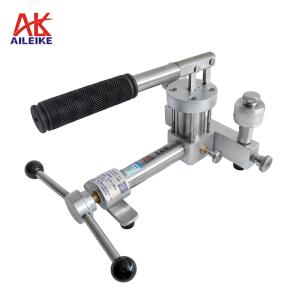
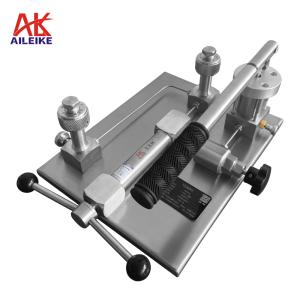
AILEIKE ALKB202 Portable Low-Pressure Pump Technical White Paper
AILEIKE ALKB202 Portable Low-Pressure Pump
Technical White Paper
1. Product Overview and Technical Background
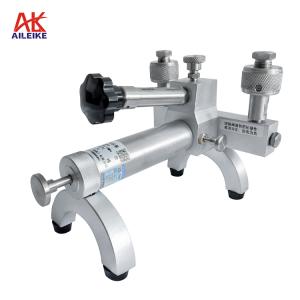
The AILEIKE ALKB202 Portable Low-Pressure Pump is a device specifically designed for the testing and calibration of positive and negative low-pressure instruments, serving as an essential tool in laboratory and industrial field pressure verification applications. It provides critical technical support for the verification and calibration of instruments such as pressure gauges, pressure transmitters, and pressure switches operating within the low-pressure range. This device prioritizes airtightness, durability, and portability as its key features, designed to facilitate your testing work.
2. Technical Specifications and Performance Metrics
2.1 Basic Technical Specifications
|
Parameter Category |
Technical Specifications |
Notes |
|
Operating Environment |
Laboratory or Field Use |
Suitable for various working environments |
|
Ambient Temperature |
-10 to 60°C |
Wide operating temperature range |
|
Relative Humidity |
<80% |
Moisture-resistant design |
|
Pressure Range |
-90 to 600 kPa |
Supports both positive and negative pressure requirements |
|
Measured Medium |
Clean air |
Excellent compatibility with various media |
|
Pressure Output |
2 |
Can connect both standard meters and test meters simultaneously |
|
Threaded Connection |
M20×1.5 or as specified by the user |
Flexible interface configuration |
|
Adjustment Precision |
min 10 Pa |
High-precision pressure regulation |
|
Dimensions |
220×90×80 mm |
Compact design |
|
Weight |
1.8 kg |
Easy to carry |
2.2 Key Performance Features
Precise Pressure Control: Utilizing advanced sealing technology, this unit offers high pressure control accuracy and smooth pressure buildup, providing a reliable pressure source for pressure testing and calibration tasks.
Wide Pressure Generation Range: With a measurement range of -90 to 600 kPa, this unit integrates both positive and negative pressure generation capabilities. It allows for easy switching between positive and negative pressures, meeting a wide range of pressure testing and calibration needs.
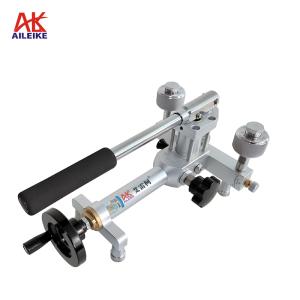
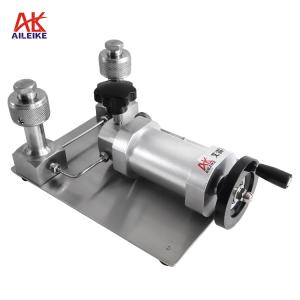
Easy Operation and Maintenance: The lever-type pressurization mechanism allows for a wide range of pressure adjustment, ensuring a stable pressurization and depressurization process with simple operation. Additionally, the open-frame design facilitates maintenance.
Portability: Compact in size (220 × 90 × 80 mm) and lightweight (approximately 1.8 kg), it is easy to carry and suitable for both field operations and laboratory calibration.
Hygienic: The pressure transmission medium is air, ensuring hygiene and preventing environmental contamination, while also helping to improve the accuracy of calibrated instruments.
3. Main Application Areas
The ALKB202 portable micro-pressure pump is widely used in the following fields:
3.1 Metrology and Testing
In the fields of thermal metrology and control within legal metrology institutions and industrial enterprises, it is used to calibrate pressure instruments (such as pressure gauges, transmitters, and sensors) and provide a stable pressure source.
3.2 Laboratory and Field Metrology
Used for laboratory and field metrology in industries such as power generation, metallurgy, petroleum, and chemical engineering, supporting the verification of precision pressure instruments.
3.3 Instrument Manufacturing
Used by pressure instrument manufacturers for factory acceptance testing and quality control to ensure that the performance specifications of shipped instruments comply with standards.
3.4 Research and Education
Used in laboratories at universities and research institutes for research and teaching experiments related to pressure measurement.
4. Operation and Maintenance Guide
Operating Procedure
Positive Pressure Testing
(1). Open the vent valve and adjust the fine-tuning knob to an appropriate position (turn the knob outward).
(2). Install the positive pressure standard gauge and the gauge under test on the two pressure output ports, then close the vent valve.
(3). Manually turn the fine-tuning knob inward to increase the pressure to approximately the calibration point, then allow the pressure to stabilize for 1–2 minutes.
(4). Once the reading on the standard gauge has stabilized, use the fine-tuning knob to adjust the pressure to the calibration point.
(5). After calibration is complete, open the vent valve. Remove the test gauge and standard gauge only after the pressure has been fully released.
If the reading slowly drops during pressurization (indicating a slight leak), close the vent valve tightly.
Negative Pressure Testing
(1) Open the vent valve and turn the fine-tuning knob inward (stop when it becomes difficult to turn).
(2) Install the negative pressure standard gauge and the test gauge on the two pressure output ports, then close the exhaust valve.
(3) Slowly turn the fine-tuning knob outward until the reading stabilizes around the calibration point for 1–2 minutes.
(4) Once the standard gauge reading has stabilized, use the fine-tuning knob to adjust to the calibration point.
(5) After calibration is complete, open the exhaust valve. Only remove the test gauge and standard gauge after the pressure has been released.
Maintenance Guide
(1) Place the micro-pressure pump on a flat, easily accessible work surface. Avoid using it in environments containing highly corrosive gases or dust particles.
(2) Ensure proper sealing at all connection points during use; inadequate sealing may cause pressure leaks.
(3) Wipe down all parts of the micro-pressure pump regularly. Ensure no liquid enters the tubing during measurements.
(4) Cover the instrument with a cloth cover when not in use to prevent dust from entering the device.
5. Conclusion
The AILEIKE ALKB202 portable micro-pressure pump features high-quality pressure-generating components, combined with a compact design, simple operation, rational structure, and excellent sealing performance. It is widely applicable in metrology, scientific research, industrial and mining enterprises, and instrument manufacturing industries.
Related News